
The salute to John Kerry by the FARC-EP
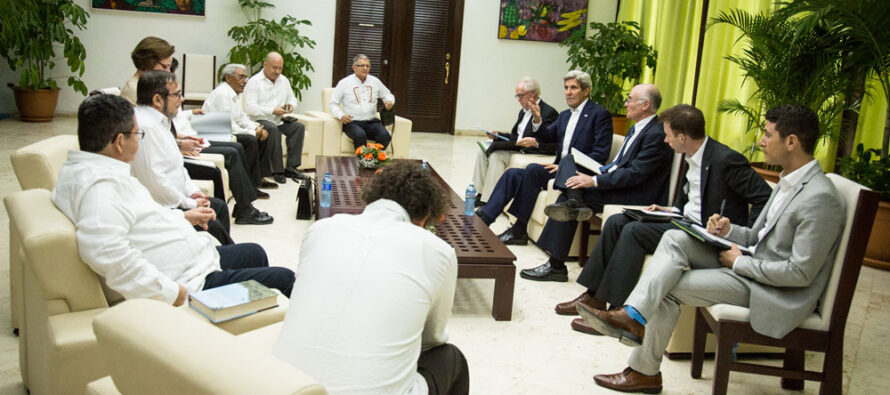

US Secretary of State John Kerry met yesterday with representatives of both the FARC-EP and the Colombian government. In a close doors meeting Kerry listened to the guerrilla leaders and confirmed the support of the US government to the peace talks taking place in Havana.
We publish below the salute to John Kerry by the FARC-EP.
Havana, Cuba, site of the Peace Talks, 21 March 2016, the year of peace
Mr JOHN KERRY, United States of America Secretary of State
Through you, we thank the US Government for its support for thepeacetalks in Havana between the Government of Colombia and the FARC-EP that seek to end the longest armed conflict in the Western Hemisphere.
Together with Norway, Cuba, Venezuela and Chile, Washington has helped to find ways of understanding between the parties at difficult moments. This has allowed an important sector of Colombian society to begin to perceive the United States as a friend of thepolitical solution, and the historic meeting with the FARC-EP in the city of Havana helps to strengthen this feeling. This has been an achievement of President Barack Obama’s administration.
We appreciate the work carried out by the special envoy of the State Department, Mr. Bernard Aronson, who has helped us to understand the vision of the US on Colombia. We hope that through you, the United States will also understand our altruistic struggle, full of ideals and humanism. After all, for decades of confrontation, the FARC-EP have done nothing but follow the just proclamation of the first Declaration of Human Rights of the planet by the good people of Virginia, June 12, 1776, reiterated on the 4th of July with these wise words:
“(…) When a long train of abuses and usurpations, which invariably pursues the same objective, evinces a design to subdue the people under absolute Despotism, it is the right of them, it is their duty, to throw off such government and to provide new Guards for their future security. (…) ”
We have reasons to believe that the US is able to see in the FARC-EP a reliable partner for the construction of the continental peace and we hope that consequently we will be recognized as a political force committed to the expansion of democracy and social progress in Colombia.
It is our intention to continue working resolutely in these few months that separate us from the Final Agreement, with the certainty that nothing is possible without providence (Nil sine numine); and everything, even the most difficult, is possible to solve with goodwill.
For this purpose we have presented a road map to the plenipotentiaries of the Government of Colombia and the guarantor countries, which contains key elements such as theCease of Fire and hostilities, the surrender of weapons, security guarantees and the end of paramilitarism.
In this regard, Mr Kerry, through you we ask the US to help curbing paramilitary violence, which amid the peace process continues taking the lives of human rights defenders and social leaders with impunity.
In addition, we propose you to help implement right away the Agreement reached at the DialogueTable on the solution to the problem of illicit crops, with the implementation of alternative economic projects and programs agreed to the benefit of farmers.
Finally, we want to express our conviction that soon we will present the good news to the country and the world that Colombia has come to peace. The steps we are taking augur well. One of the most important is undoubtedly the adoption of Resolution 2261 by the UN Security Council, which establishes a political mission in charge of monitoring theBilateral ceasefire and hostilities, as well as the abandonment of weapons.
Let’s work so that the aspiration for Latin America and the Caribbean to be a zone of peace, can become a reality.
PEACE DELEGATION OF THE FARC-EP
Related Articles
Six years ago Roboski Massacre
On the night of 28 December 2011, Turkish Armed Forces’ warplanes bombed an area on the border with Southern Kurdistan

GIORNALISTA “ARRESTA” LIEBERMAN. CENSURATO
Il servizi televisivi della Unione Europea sono stati protagonisti di un palese episodio di censura. Il giornalista irlandese del The
SDF Commander Abdi on ceasefire agreement SDF Commander-in-Chief of General Mazlum Abdi evaluated the agreement reached between Turkey and the US on Ronahi Tv
SDF Commander-in-Chief of General Mazlum Abdi said: “This is a start. The Turkish state has not stopped the invasion. Our people, our
